- Press Office
- Press releases 2025
- Unseen Allies: Symbiotic Bacteria help clean Wastewater
Unseen Allies: Symbiotic Bacteria help clean Wastewater, but there is a Catch
TO THE POINT:
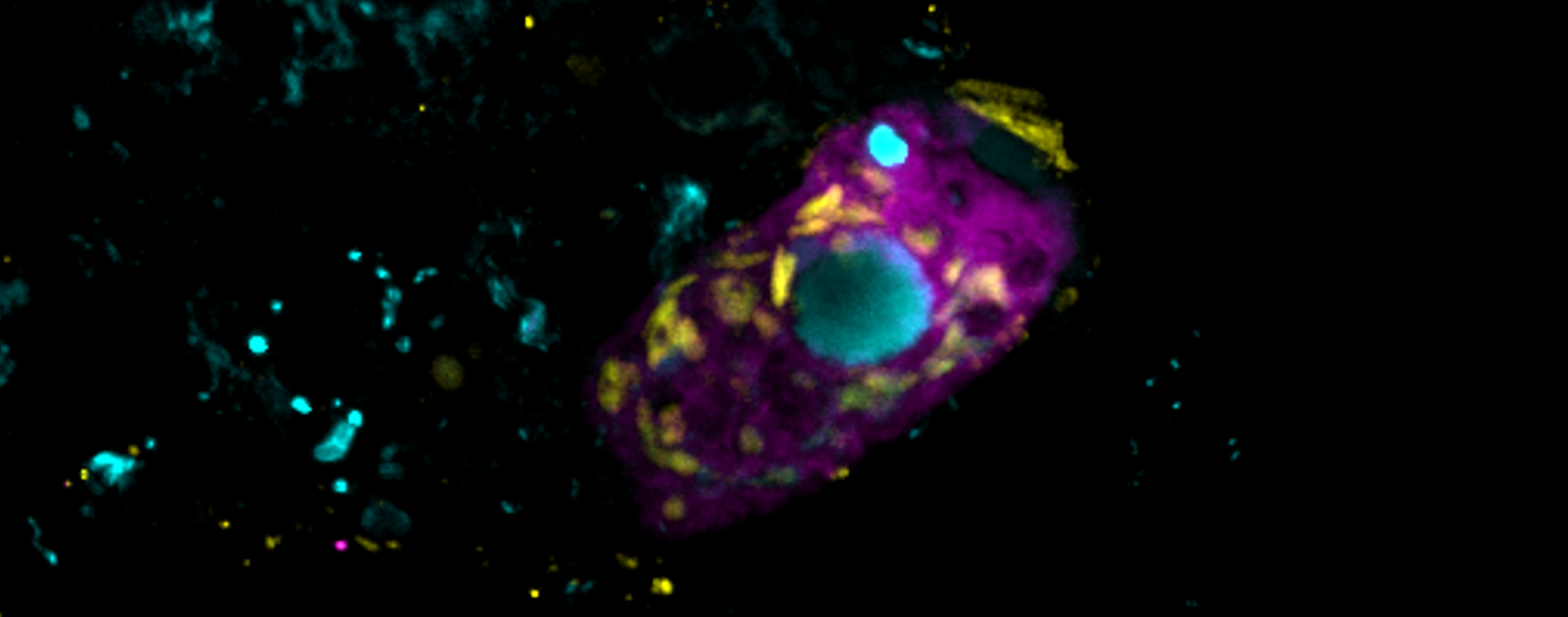
- New symbionts in wastewater: Researchers have discovered 14 new species of symbiotic bacteria in wastewater treatment plants around the world that live in single-celled host animals and remove nitrate from wastewater.
- Climate-relevant side effect: One particularly common species releases nitrous oxide (N₂O) – a powerful greenhouse gas that is 300 times more climate-impacting than CO₂.
Wastewater treatment is essential for protecting public health and the environment. In sewage plants, a diverse microbial community removes pollutants from agricultural, industry and household wastewater. Most research has focused on free-living bacteria within this community, but a new study now reveals that microbial partnerships – bacteria living inside other microbes – are also widespread and active.
Microbes teaming up
A few years ago, a team of researchers around Jana Milucka from the Max Planck Institute for Marine Microbiology in Bremen, Germany, discovered peculiar bacterial symbionts that associate with ciliates, single-celled organisms that can be found everywhere where there is water. The symbionts supply their hosts with energy, much like how mitochondria power our own cells – an until then unprecedented association. The researchers’ data indicated that these organisms might be especially common in wastewater, so the team decided to investigate this further.
Common members of the wastewater microbiome
Analysing data from sewage plants all over the world, the scientists identified 14 new species of these endosymbiotic bacteria. “By performing denitrification, the bacteria contribute to nitrate removal, a key step in wastewater treatment. At the same time, they help their hosts generate energy by converting harmful nitrates into dinitrogen gas,” first author Louison Nicolas-Asselineau explains. The scientists detected these partnerships in up to half of the wastewater plants, suggesting they are a common but previously overlooked part of this ecosystem. And they might be even more abundant: “We see that the symbionts’ numbers fluctuate a lot over time within individual sewage plants, so it is possible we might have missed a few.”
A climate concern

Denitrifying endosymbionts, including the newly identified wastewater species, typically encode a complete denitrification pathway that enables them to respire nitrate all the way to dinitrogen gas (N2). Additionally, most of these endosymbionts also possess an enzyme called cytochrome-cbb3 oxidase that allows them to respire oxygen in addition to nitrate.
However, one species stands out: Candidatus Azoamicus parvus not only lacks the ability to breathe oxygen but it is also unable to further break down nitrous oxide (N₂O), an intermediate of the denitrification process. Instead of converting N2O into the harmless N2, it releases this potent greenhouse gas into the surrounding water. Nitrous oxide is 300 times more powerful than CO₂, and wastewater treatment is known to contribute to anthropogenic N2O emissions to the atmosphere.
Worryingly, this species is widespread in sewage plants globally. “This is the first time we have ever found a denitrifying endosymbiont that produces nitrous oxide and it happens to be the one that is most widely distributed in wastewater treatment plants,” says Jana Milucka, the study's senior author.
Why it matters
Wastewater treatment is one of the largest applications of microbiology, essential for the preservation of natural environments as well as human health. The microbial partnerships now described in the journalISME Communicationshave been widely overlooked. “We were very surprised that denitrifying endosymbioses were so abundant and prevalent in wastewater, given the dynamic conditions and intense ecological pressures in these systems”, says Nicolas-Asselineau. “Our study highlights the need to better understand the microorganisms involved in the wastewater processes, as they might be the key to improving wastewater treatment and reducing its environmental impact.”
A podcast on the topic from detektor.fm (only available in German)
New symbionts in wastewater produce nitrous oxide
Researchers have discovered new bacterial partnerships in sewage treatment plants around the world that play a surprising role in the climate. While these microorganisms help purify wastewater, some of them produce the dangerous greenhouse gas nitrous oxide.

Der Podcast von detektor.fm
Original publication
Louison Nicolas-Asselineau, Daan R Speth, Linus M Zeller, Ben J Woodcroft, Caitlin M Singleton, Lei Liu, Morten K D Dueholm, Jana Milucka (2025): Occurrence and temporal dynamics of denitrifying protist endosymbionts in the wastewater microbiome, ISME Communications, Volume 5, Issue 1, January 2025, ycaf209
Participating institutions
Max Planck Institute for Marine Microbiology, Celsiusstrasse 1, 28359 Bremen, Germany
Centre for Microbiome Research, School of Biomedical Sciences, Queensland University of Technology, 37 Kent Street, Woolloongabba QLD 4102, Australia
Center for Microbial Communities, Department of Chemistry and Bioscience, Aalborg University, Fredrik Bajers Vej 7H, 9220 Aalborg, Denmark
Contact
Group Leader
Greenhouse Gases Research Group
MPI für Marine Mikrobiologie
Celsiusstr. 1
D-28359 Bremen
Deutschland
|
Room: |
3128 |
|
Phone: |

PhD student
MPI for Marine Microbiology
Celsiusstr. 1
D-28359 Bremen
Germany
|
Room: |
3137 |
|
Phone: |

Head of Press & Communications
MPI for Marine Microbiology
Celsiusstr. 1
D-28359 Bremen
Germany
|
Room: |
1345 |
|
Phone: |
