- Departments
- Department of Ocean Biosphere Dynamics
- Biogeochemical Prediction Research Group
Biogeochemical Prediction Research Group
Group Leader
Biogeochemical Prediction Research Group
MPI for Marine Microbiology
Celsiusstr. 1
D-28359 Bremen
Germany
|
Room: |
2125 |
|
Phone: |

The Biogeochemical Prediction Group investigates how the global carbon cycle and ecosystem-relevant ocean stressors and extremes evolve across timescale - from near-term variability to long-term climate change. The carbon cycle is central to the Earth system as it connects physical climate dynamics with biogeochemical processes, shapes the accumulation of CO₂ in the atmosphere, and influences climate risks and mitigation pathways.
A key scientific challenge is understanding how natural climate variability and human-driven change interact with ocean biogeochemistry and marine ecosystems. These interactions influence the ocean’s capacity to absorb carbon and the combined pressures of ocean warming, acidification, and oxygen loss.
With Earth System modelling and AI/ML approaches combining observational evidence, we address how marine biogeochemical change translates into ecosystem stress and climate feedbacks. Our vision is to build an interdisciplinary research program that links process understanding with a special focus on the pathways from microbial mechanisms to large-scale Earth system variability, prediction, and projection.
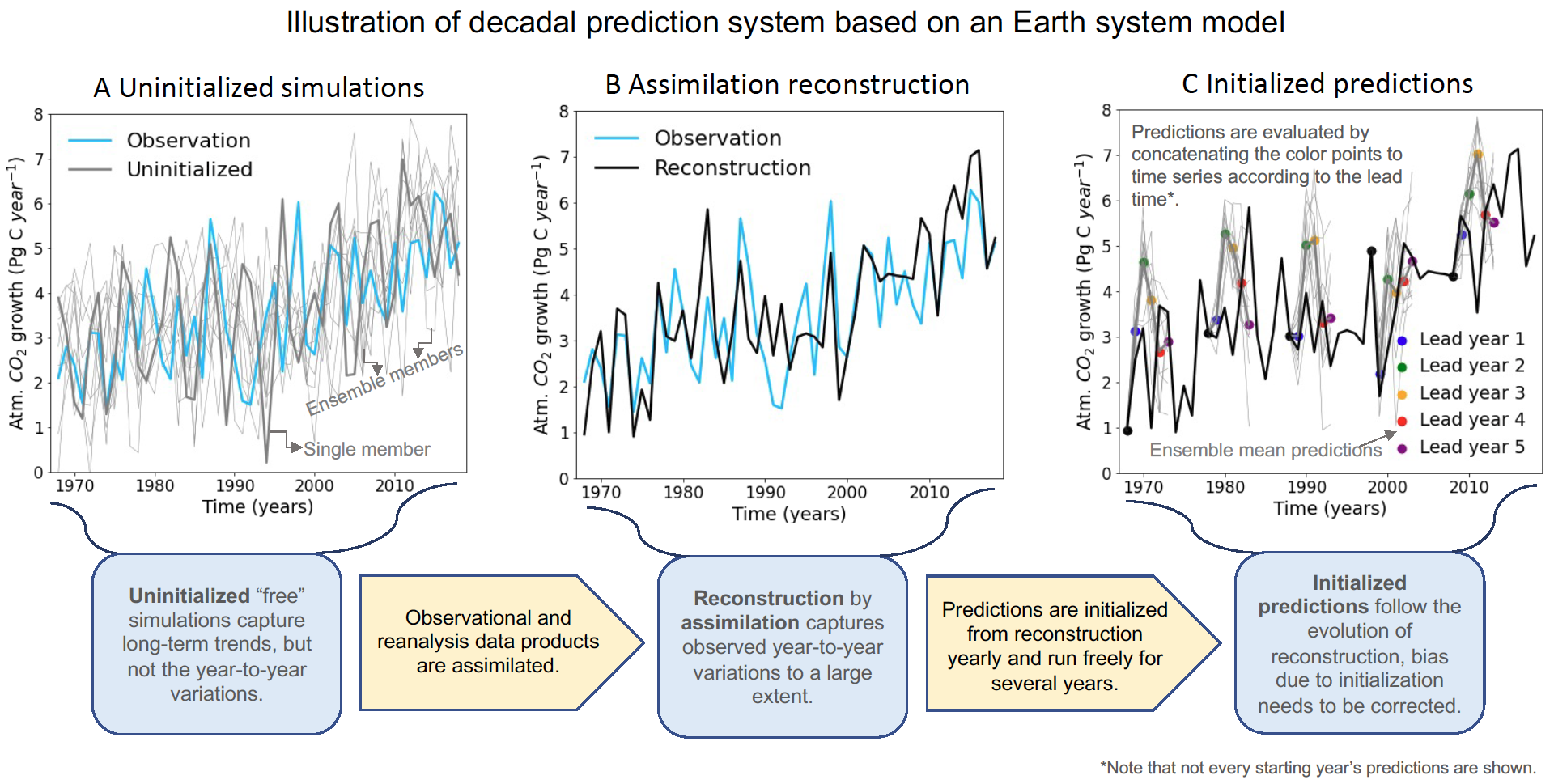
Source: Li et al. (2023), Reconstructions and predictions of the global carbon budget with an emission-driven Earth system model, CC BY 4.0