- Abteilungen
- ERC-Forschungsgruppe für Ökologische Genomik
ERC-Forschungsgruppe für Ökologische Genomik
Projektleiter
ERC-Forschungsgruppe für Ökologische Genomik
Luis Humberto Orellana Retamal
MPI für Marine Mikrobiologie
Celsiusstr. 1
D-28359 Bremen
|
Raum: |
2226 |
|
Telefon: |

Unsere Gruppe nutzt multi-omische Ansatz und molekularbiologische Methoden, um das genetische Potenzial natürlicher mikrobieller Gemeinschaften zu erschließen und es mit den Prozessen in Verbindung zu bringen, die wichtige biogeochemische Kreisläufe antreiben.
Zwei zentrale Ziele bestimmen unsere Forschung:
- Die Entwicklung genomischer und metagenomischer Methoden, um aus komplexen Omics-Datensätzen überprüfbare Hypothesen abzuleiten.
- Der Einsatz von multi-omischen Technologien und fortschrittlichen Bildgebungsverfahren, um die Evolution und Interaktionen häufig übersehenener mariner Bakterien zu untersuchen.
Ökologische und evolutionäre Rolle spezialisierter Bakterien für die Gesundheit von Algen und die Kohlenstoffbindung – ERODERS
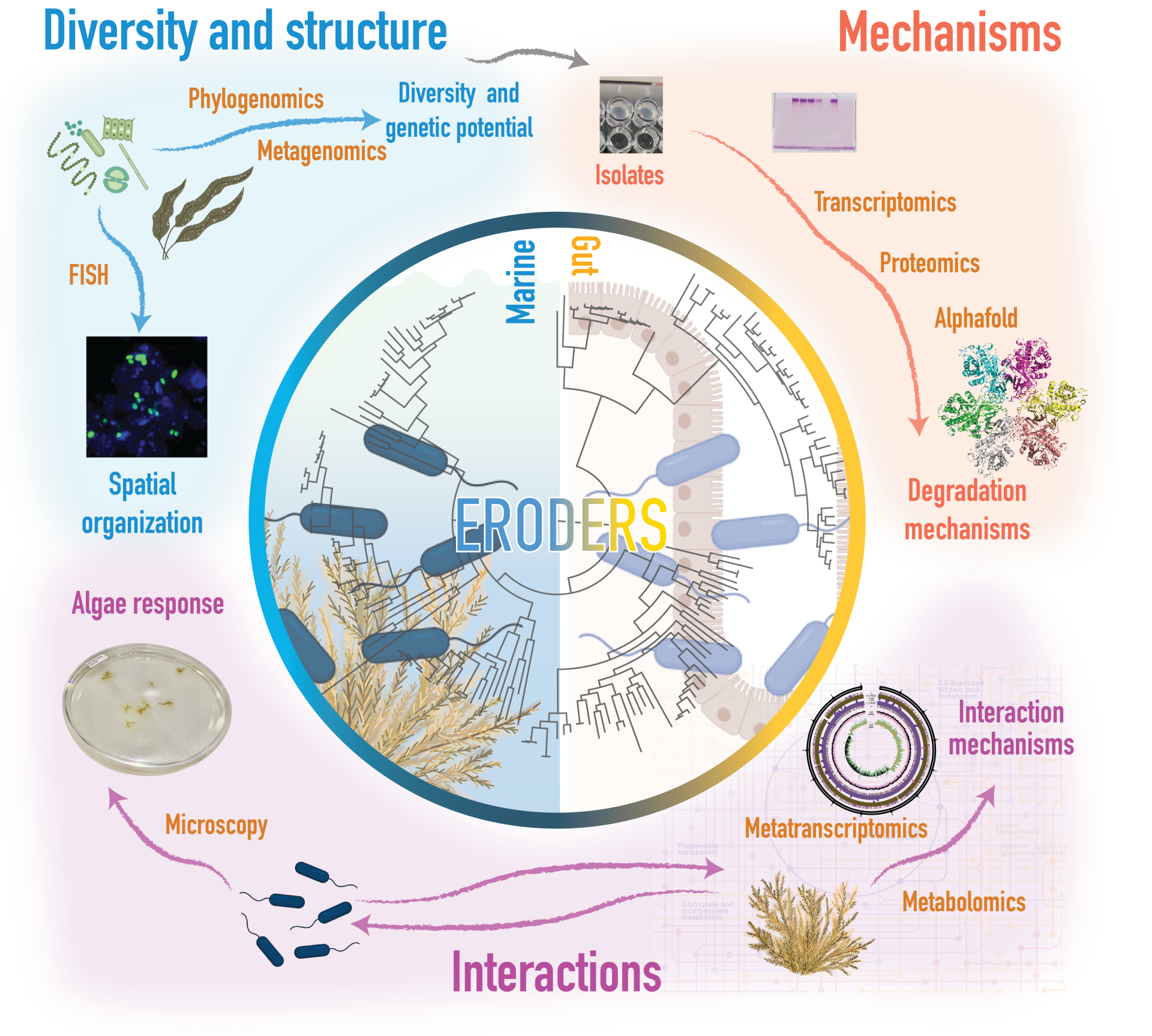
Das Projekt ERODERS konzentriert sich auf bislang nicht erfasste Bakterien, die in der Lage sind, schwer abbaubaren organischen Kohlenstoff zu zersetzen – komplexe Verbindungen, die hauptsächlich aus Algenstrukturen und Exsudaten stammen.
Wir vermuten, dass sich diese spezialisierten Bakterien, als integraler Bestandteil des Algen-Mikrobioms, von komplexen Glykanen ernähren und eine Koevolution mit den Algen durchlaufen haben. Ihre Aktivität könnte entscheidend sein für die Gesundheit ihrer Wirte und die Struktur mariner Polysaccharide die zur langfristigen Kohlenstoffbindung im Ozean beitragen, verändern.
News (updated 14.11.25)
November 11th, 2025
New group picture!

October 31st, 2025
In this short article, I revisit the paper by Kostas Konstantinidis and James Tiedje that introduced average nucleotide identity (ANI), a metric that reshaped how we map microbial diversity, compare species, and link genomes to ecology. I explore where this idea came from and why it continues to matter for microbial ecology.
Average nucleotide identity — the backbone of modern ecological genomics
September 16th, 2025
Great energy at the 2025 SALTO Symposium we organized at the Max Planck Institute for Marine Microbiology! Researchers from Germany, France, Spain, Portugal, and Australia joined us in Bremen to explore the evolutionary links between specialized bacteria and their algal hosts.
This symposium took place within the framework of the SALTO program, a collaboration between the Max Planck Society (MPG) and the Centre national de la recherche scientifique (CNRS). We're grateful to everyone who made this event possible.

August 3rd, 2025
For the past three weeks, we were delighted to host Iva Comar from Barcelona in our lab. She was selected to participate in the Youth and Science program organized by the Pedrera Foundation in Spain. During her stay, we explored the diversity of specialized bacteria associated with brown macroalgae using metagenomic approaches.
Good luck at Uni Utrecht, Iva — we’re sure you’ll do amazing! We can’t wait to see what you do next.

June 17th, 2025
Excited to share our latest work led by Tomeu! We deeply sequenced water column and sediment metagenomes using PacBio. Among the key findings: Woeseiaceae bacteria adapt to benthic vs. planktonic niches with distinct metabolic strategies. Check it out!

June 16th, 2025
We are happy to welcome Jasmin Tesani to our group for an Erasmus Traineeship. Jasmin earned her MSc in Marine Microbiology from the University of Copenhagen. We look forward to having you with us this summer!

June 1st, 2025
We are happy to announce that Tomás Sauma is starting his PhD with us! He will combine genomic and visualization approaches to determine the diversity and spatial location of specialized bacteria living on algae. He will also use computational methods to understand genome size and evolution in bacteria. Good luck!

May 14th, 2025
C. Belén Pareja is joining our group for six months! She is a PhD student from Rodrigo De la Iglesia's LabMicMar group in Chile. She studies microbial communities in marine epilithic biofilms, specifically in the rocky intertidal environment of Central Chile. "Who is where and when?" and "What are they doing?" are some of the questions she is trying to answer. She won an ANID scholarship that funds her stay and research here. Good luck!
