- Press Office
- Press releases
- Caught in the act
Caught in the act: a gene jumps into the void
Jumping genes accelerate evolution
Jumping genes are parasites in the genetic material of bacteria, plants, animals and humans. They are released into the cell as small RNA molecules from ribonucleic acid (RNA) and possess complex mechanisms for inserting themselves into other parts of the genetic material within the cell, thereby often conferring new properties on the cell and thus accelerating evolution. There are also jumping genes that free themselves from the RNA using an RNA enzyme. These ribozymes or self-splicing introns are a special group of jumping genes.
It is more difficult for a gene to jump into another cell or another species. Phylogenetic analyses of genes show that such jumps have taken place. Until now, it had been assumed that, for this to happen, the jumping genes travelled as ‘hitchhiker’ in the genomes of plasmids or viruses. Now, Jens Harder and his colleagues have made a surprising observation.
An anaerobic community on the scent of oranges
A slowly growing, methane (biogas)-producing enrichment of bacteria and archaea harboured an unusual community: the most abundant member was a very small predatory bacterium. Candidatus Velamenicoccus archaeovorus feeds on the microorganisms that break down limonene, the scent of oranges, into methane and carbon dioxide. Individual cells within the filaments of Methanothrix soehngenii, the most significant methane producer on Earth, were dead.
Could Ca. Velamenicoccus archaeovorus be the cause of death? To confirm this, molecules of Ca. Velamenicoccus archaeovorus would need to be detected in the dead cells.
In Search of Intron RNA
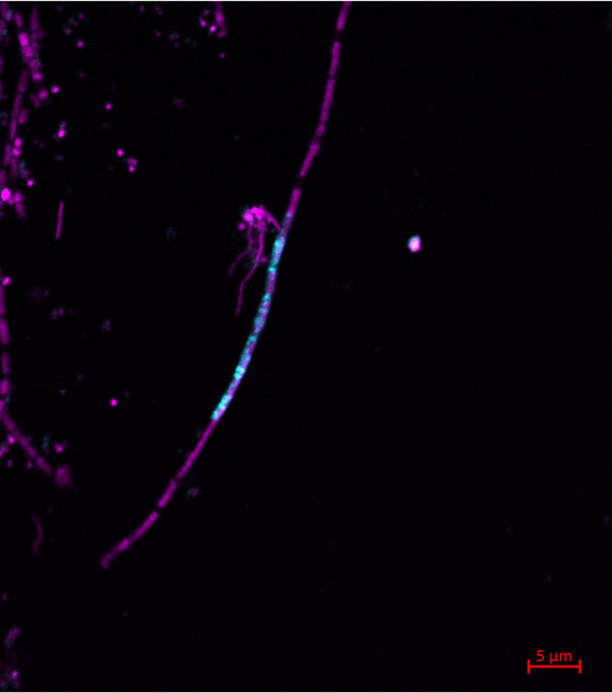
Whilst analysing the genome of Ca. Velamenicoccus archaeovorus, Jens Harder discovered a jumping gene, an intron. Although – and precisely because – intron RNA had never before been observed outside a cell, Jens Harder decided to look for the intron in the prey of Ca. Velamenicoccus archaeovorus.
The Max Planck Institute for Marine Microbiology has developed suitable methods capable of detecting small amounts of RNA in bacterial cells. Following the development of specific nucleic acid probes, microscopic images revealed the presence of intron RNA in living cells of Ca. Velamenicoccus archaeovorus and in dead cells of Methanothrix soehngenii.
Caught red-handed? Yes, whilst the intron was attempting to replicate. However, the carrier of the intron, Ca.Velamenicoccus archaeovorus, had already killed the new host. Thus, the attempt ended with a leap into an empty cell.
Stable RNA
Ribonucleic acids are the messengers in living cells. They are long chain molecules that carry the cell’s blueprints from the genetic material to the protein factories, and are then broken down very quickly from the end. Dead cells do not normally contain ribonucleic acids.
However, the survival of intron RNA in cells is not surprising, as the intron forms a circular RNA with no open ends, which is resistant to degradative enzymes. “The stability of intron RNA in its ring form is a distinctive feature. In humans, circular RNA molecules influence many metabolic processes, and their role in tumour development is currently the subject of intensive research. Applications in RNA vaccines, for example against the Covid virus and certain forms of cancer, are also in the pipeline. Our study has shown that in microorganisms jumping genes can be transferred to other species via their circular RNA,” says Jens Harder.
Original publication
Kizina, J., Lonsing, A. & Harder, J. Mobile intron RNA from a bacterial predator accumulates in dead archaeal cells. Sci Rep 16, 14654 (2026).
Please direct your queries to:
Scientist
Department of Ocean Biosphere Dynamics
MPI for Marine Microbiology
Celsiusstr. 1
D-28359 Bremen
Germany
|
Room: |
2125 |
|
Phone: |

Head of Press & Communications
MPI for Marine Microbiology
Celsiusstr. 1
D-28359 Bremen
Germany
|
Room: |
1345 |
|
Phone: |
